
Risk assessment for trees begins with identifying specimens where risk tolerance is low and plant preservation is prioritized. The signs and symptoms used for assessing tree risk have been detailed in a previous article. Today, we’ll outline an advanced assessment which was performed on a tree at Alphawood Arboretum at Illinois Tech.
The arboretum collection currently holds 1800 trees and woody shrubs. The stand dynamics (demographics) is composed of large populations of honey locust, elms, hackberry, oaks, and a number of other genera. However, the campus collection holds one single eastern cottonwood tree (Populus deltoides). Eastern cottonwood is a native tree species, named after the proliferation of cottony wind carried seeds the tree can produce in the summer months. Eastern cottonwood is a dioecious tree, meaning individual trees can be pistillate (female) or staminate (male). Pistilate trees produce the seed and staminate trees produce the pollen. The specimen tree in the arboretum collection is a male tree and does not produce seeds in summertime.
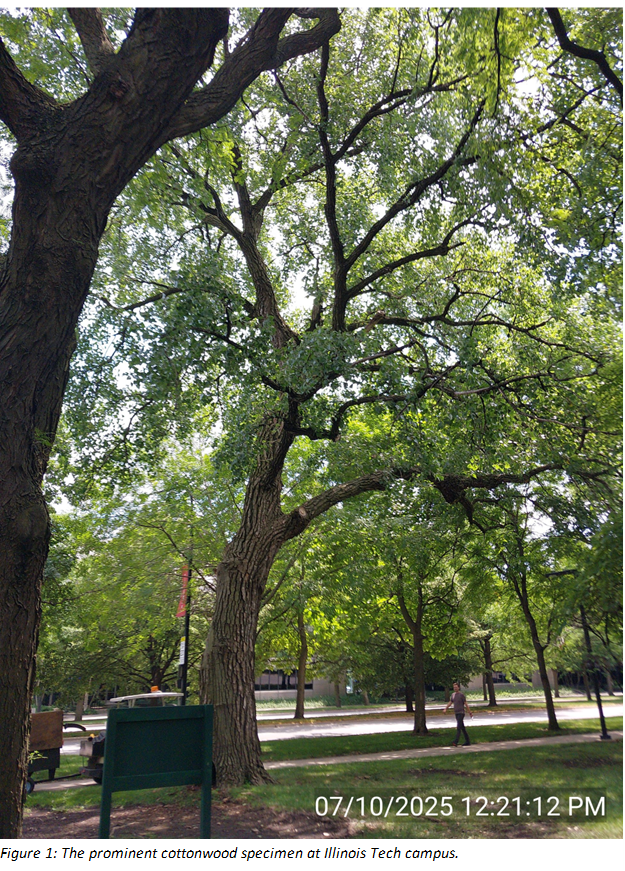
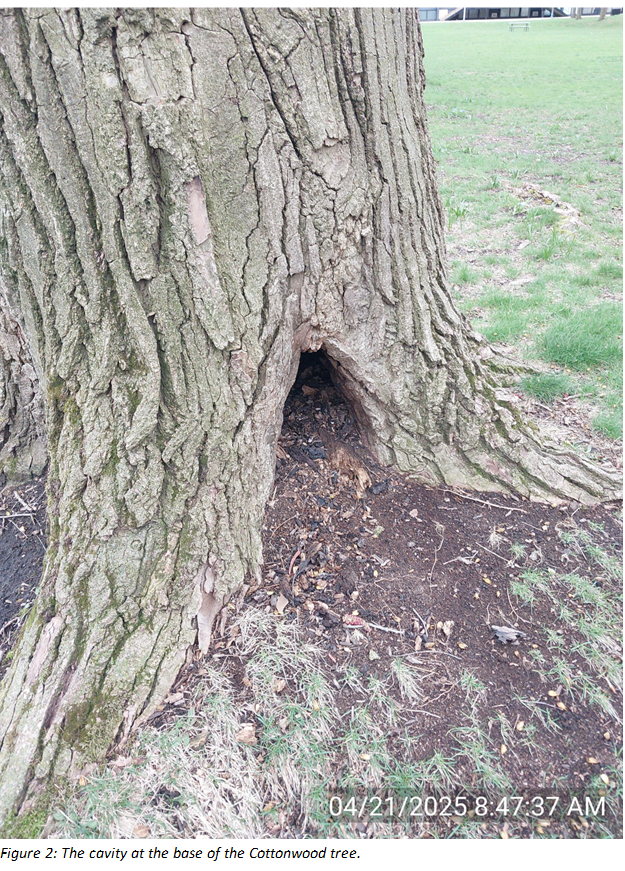
The cottonwood tree previously suffered a large limb failure. The specific year of this failure is unknown. The failure opened a tear-wound inside the main trunk. This wound exposed a large section of the tree’s internal wood tissue and allowed decay organisms to infiltrate the wood. This natural process hallowed out the interior of the trunk and left a sizable cavity from the base of the trunk up to about 10 feet up the trunk.
Illinois Tech staff decided it was prudent to perform a risk assessment and examine potential risks involved with retaining the tree. A basic inspection mapped the visible extent of the cavity. Basic non-intrusive analysis was evaluated to consider potential failure targets and consequences of impact. Further evaluation was needed to inform decision making. Illinois Tech staff reached out to fellow tree advocates from Morton Arboretum to help us perform further assessment with advanced technical diagnostic equipment.
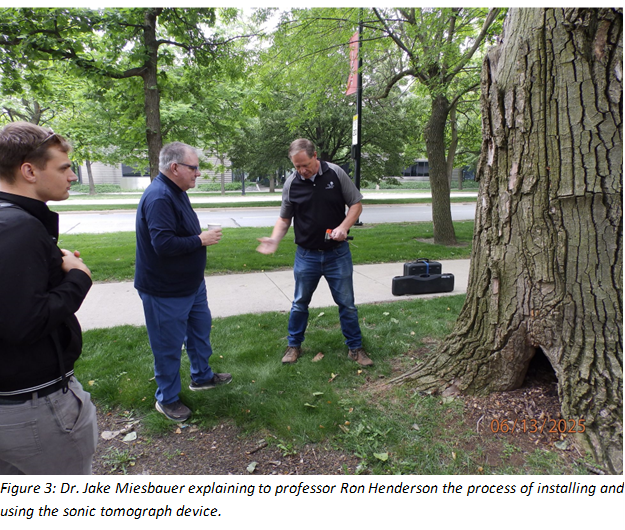
Dr. Jason (Jake) Miesbauer performed the advanced assessment using a tool called a sonic tomograph. His assistance was recruited with help from Kris Bachtel, recently retired VP of horticulture at Morton Arboretum. Miesbauer has an extensive research background on arboriculture and tree bio-mechanics and is an outstanding expert and consultant at the forefront of the industry.
The sonic tomograph goes by several different trade names, but these devices all work in similar principal; by penetrating the tree with sonic pressure waves and calculating the location and extent of decayed wood using the velocity of the wave proliferation throughout the testing area. Pressure waves move more quickly through uncompromised wood and more slowly through decaying wood or around hallow cavities. It’s about as technical as the tree care industry gets! However, it’s a simple tool to setup and use.
First, a series of probes are attached to the tree part being examined, usually by a long nail driven just deep enough to reach heartwood. In our case, 12 sonic probes were used. The probes attach to the protruding nails via magnets. Distance between each nail is measured with high precision and entered into a computer. Software creates a digital cross-sectional view of the wood using the precise distance measurements. After this setup is complete, each nail is tapped gently with a small hammer three times in succession. Each tap sends a pressure wave through the tissue, and the velocity of that pressure wave is calculated by each other sonic probe. This calculation creates an accurate view of the structure of the interior wood through digital imaging.
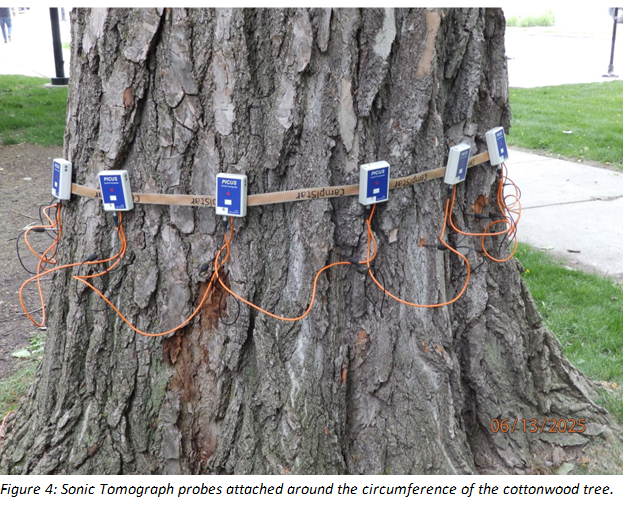
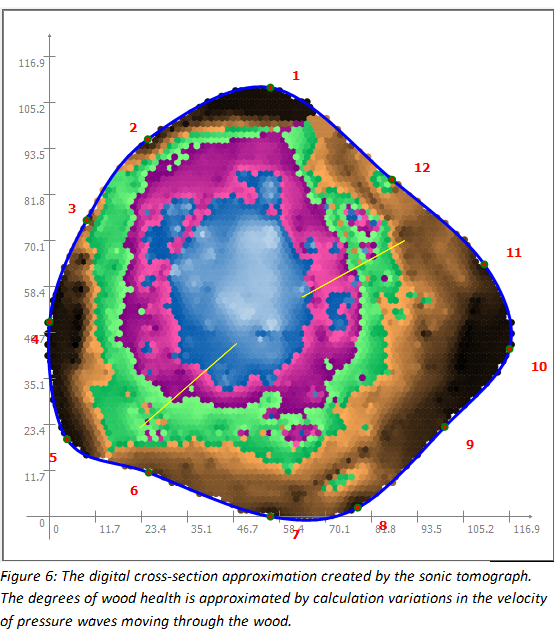
Two sections were scanned and imaged. The digital cross-sectional views helped staff discover and map the extent of decay inside of the trunk. With this advanced image of the internal structure, a plan could be constructed about what treatments would be necessary to mitigate the risk associated with retaining the tree. The advanced assessment showed that a significant cavity existed inside the trunk. However, a fair amount of sound wood was still present and the tree was actively growing in response to the wound. The risk of failure was acceptable after future mitigating factors were implemented. In a future article, we’ll be detailing the additional treatments being used to keep this important specimen tree alive and healthy. We want to take the opportunity to thank Dr. Miesbauer and Kris Bachtel from Morton Arboretum for contributing their time and expertise, and the two assistants working with Miesbauer during the assessment: Jalen Stovall and Kevin Townsend. Thank you for reading!