
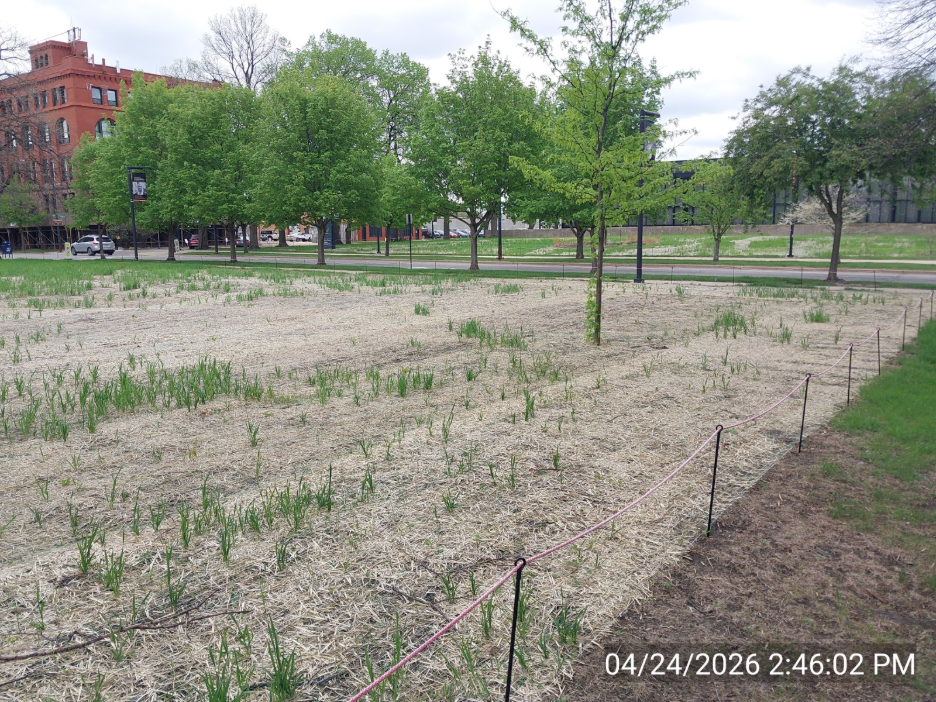
If you’ve been walking through the campus along 33rd street this spring, then you’ve undoubtedly noticed the steady proliferation of new greenery emerging through the straw blanket at our newly installed prairie. The prairie is a collaborative project between Alphawood Arboretum at Illinois Tech and Pizzo Group. These grassy plants are the first pioneer species to germinate in spring following the 33rd Street Prairie groundbreaking last November. Establishing a native prairie is a multi-year process, and this is the first spring for these plants. Let’s get to know what’s emerging and discuss what’s to come.
Why were the seeds sown last fall? Why not wait until spring to sow the seeds and give everything the chance to grow immediately? Well, there’s an evolved trait in native plant seeds that makes spring germination almost impossible! It may be hard to believe a seed can be so smart, but many native plant seeds require a period of cold temperatures before they can successfully germinate. This process is called stratification. Many native plants employ this strategy as a sort of natural timer. By scattering seed during the growing season of one year and needing a period of stratification before germinating, the plant ensures new seedlings will have time to establish before cold weather may set in and kill the tender new seedlings. Think about the time scale: if a seed is dropped into the soil and germinates in October, then it has a very short period of time to grow roots down into the ground before winter temperatures start to drop below freezing. However, evolving a seed that naturally stays dormant until a period of cold temperatures comes and goes ensures that newly germinated seedlings will begin to grow while the air temperatures are mild and moisture is abundant.
The first plants emerging in the 33rd Street Prairie are not native at all, but rather a temporary oat cover crop. This plant is included in the prairie mix to help shade the ground and out-compete other weed seeds. It acts as a sort of stopgap while the prairie plants take a bit longer to develop and establish.
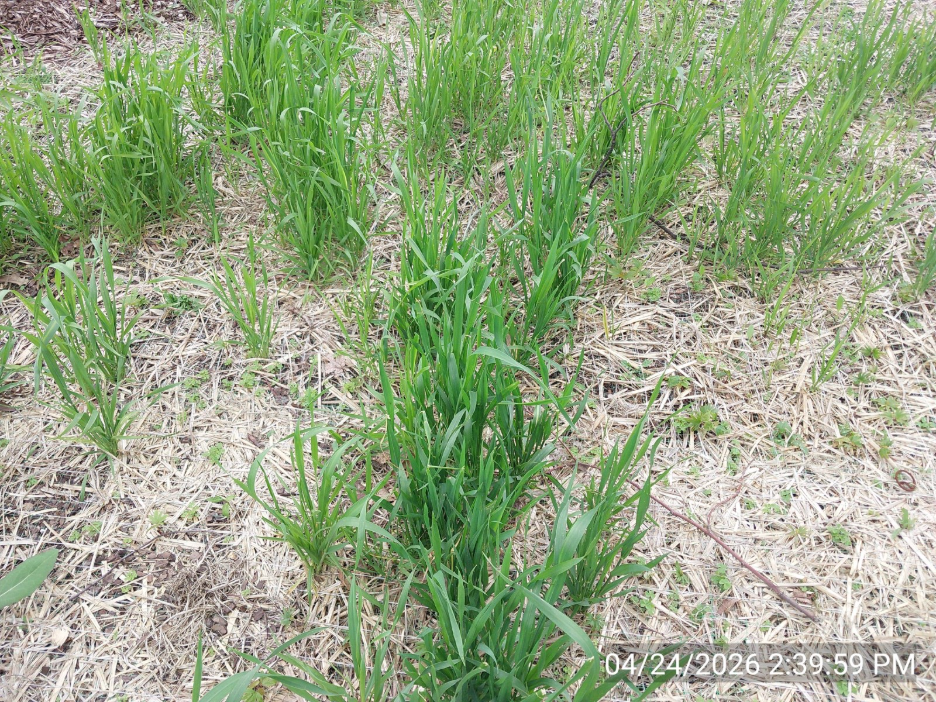
Oats are uniquely beneficial in a number of ways. They produce a natural herbicidal chemical compound, also called an allelochemical, which suppresses the germination and development of some competing weed seeds. This chemical production is an evolutionary strategy employed by a number of plants. The suppression of other seeds in early spring gives the oats a leg-up to start growing while other seeds are restrained in a chemically induced dormancy. Allelochemicals work in a number of ways, such as inhibiting the development of certain tissues or stimulating growth in a detrimental way. Black walnut trees famously produce an allelochemical called Juglone, which is a notorious allelochemical for quashing many gardeners’ hopes of planting understory plants in the tree’s shade. Black walnut even has the botanical name Juglones nigra after the chemical it produces. The oat allelochemical is much less persistent and serves to limit early spring weed seed germination while much of the ground is still bare.
Oats also provide nutrient foraging and enrichment. The roots of this cover crop will seek out and gather various nutrients from the soil, including macronutrients and micronutrients. This effect enhances the quality of the soil and boosts nutrient availability for the incoming prairie plants. As they grow, the oats will also rapidly produce biomass, which will later die back and provide additional organic matter to the soil. In agriculture, we call this a green manure crop. The plant dies or is killed off later in the season, and the biomass is allowed to decompose in place. Some agriculture practices also till (mechanically incorporate) the biomass into the soil. This decomposition process will attract myriad microorganisms and invertebrates, which will consume the decomposing oat plants and further enhance the soil quality through this process. Oats are only hardy to around zone 7, meaning they cannot survive typical Illinois winter conditions. The temporary cover crop will die naturally due to winter weather without the need for herbicides or mechanical control. It’s a completely natural and beneficial process!
The oat cover crop will remain in the prairie for the rest of 2026, providing shade to the soil and suppressing weed growth while giving the other prairie plant seeds a chance to germinate and establish. Once the other prairie plants grow into the space, they will outcompete most weed plants that happen to enter the space. The next seed to germinate will be some of the earlier blooming varieties, including Golden Alexander (Zizia), Blazing Star (Liatris sp.), and a number of sedges (Carex sp.) , although there won’t be many blooms during the first year of establishment and growth.
The full mix information is available on the Pizzo website here: https://www.pizzonursery.com/wp-content/uploads/2024/08/seeds_lowprofile_prairie.pdf
The 33rd Street Prairie is an initiative of The Alphawood Arboretum at Illinois Institute of Technology in collaboration with Pizzo Group, restoration ecologists with national expertise in conserving and restoring natural environments. Their “Low Profile Prairie” seed mix is the foundation of our new 1.2 acre prairie, which will continue to grow and mature over the next three years, at which time it is intended to receive a controlled burn as part of the process of establishing a healthy and biodiverse landscape.